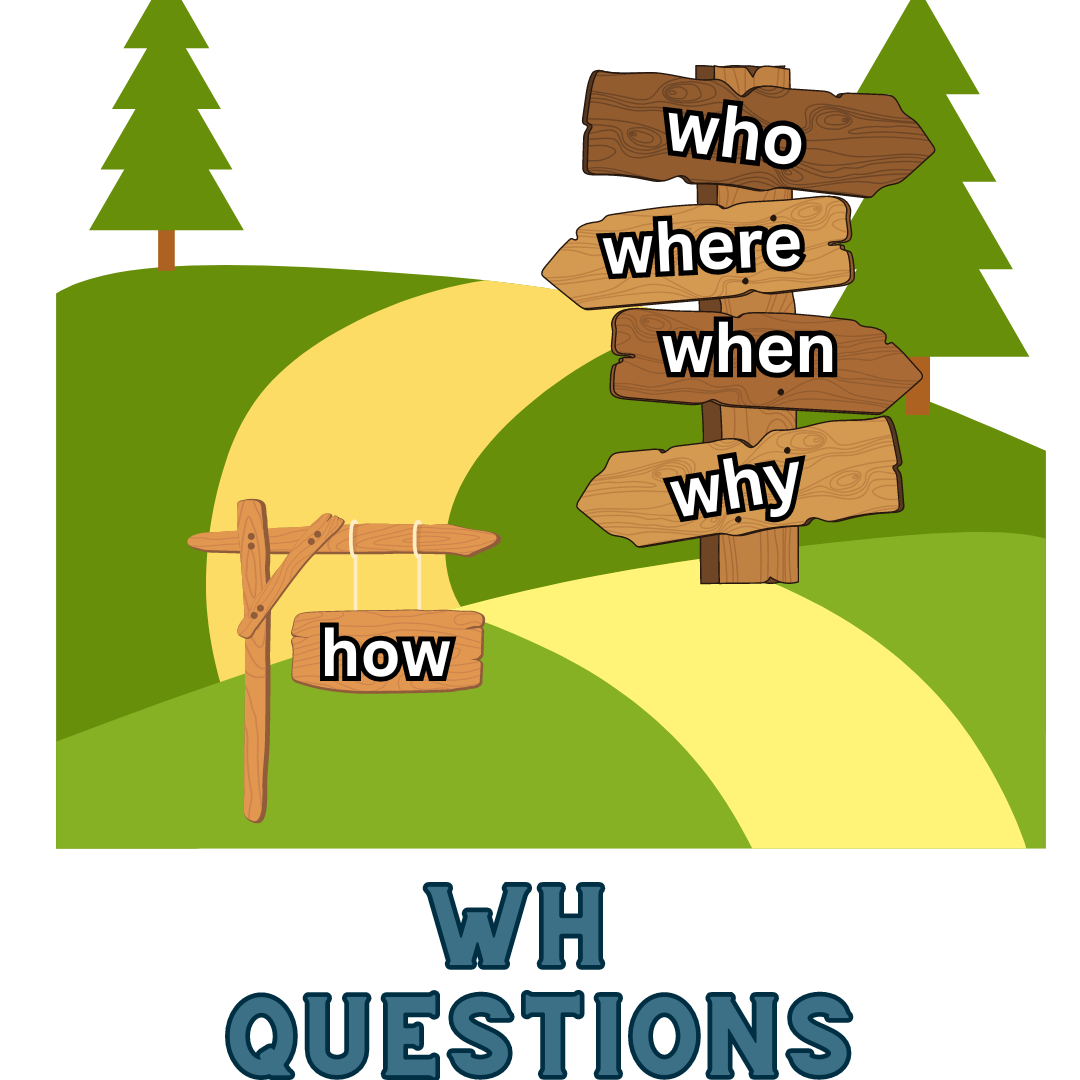
If you’ve worked with children who struggle to answer WH-questions — who, what, where, when, and why — you already know how important this skill is. WH-questions form the foundation for conversation, comprehension, and classroom learning. Without them, students can’t explain, infer, or fully connect ideas.
The good news? WH-questions don’t have to be practiced through flashcards or drills. When we turn them into games, kids stay engaged, talk more, and learn naturally through play. Whether you’re in a school setting, clinic, or teletherapy session, there are tons of fun and effective ways to target WH-questions across all ages and ability levels.
In this guide, we’ll explore the best speech therapy games that target WH-questions — all classroom-friendly, therapist-approved, and many available free on FreeSLP.com. You’ll find in-person, digital, and no-prep options you can use right away.
Why WH-Questions Matter
WH-questions build both expressive and receptive language. They help children:
-
Understand stories and conversations
-
Express reasoning and emotions
-
Build vocabulary and grammar naturally
-
Engage in social interaction and classroom discussions
When students can confidently answer and ask WH-questions, they become stronger communicators and readers. Teaching these skills through play keeps therapy meaningful and fun.
1. Classic Board and Card Games for WH-Questions
1.1. FreeSLP.com WH-Question Board Game
This is a fan favorite for a reason. Each color-coded space corresponds to a WH-question type — “who,” “what,” “where,” “when,” or “why.” Students roll, move, and answer. You can play online or print it for tabletop use.
SLPs love it because it’s flexible — one board works for any group size and any goal. The prompts range from simple (“What do you eat for breakfast?”) to complex (“Why do people celebrate birthdays?”).
1.2. “WH-Bingo”
Make or print a simple bingo board with pictures and words representing question answers (e.g., a park, teacher, pizza, nighttime). Read WH-questions aloud, and students mark the matching answer.
This builds auditory comprehension and quick retrieval. It’s easy to scale for younger or older learners — just adjust your question complexity.
1.3. “Question Detective”
Cut up question cards, hide them around the room, and give students magnifying glasses or pointers. When they find a card, they must read and answer it.
It’s a wonderful kinesthetic warm-up that helps active students stay engaged. You can find printable “Question Detective” cards for free on FreeSLP.com’s Language Games section.
2. Digital and No-Prep WH-Question Games
2.1. FreeSLP.com Digital WH-Question Spinner
Perfect for teletherapy or in-person play, this digital spinner randomly lands on “who,” “what,” “where,” “when,” or “why.” Once it stops, you ask a question or show a picture related to that word.
You can even add your own custom prompts. It works great for quick warm-ups or transitions between activities.
2.2. Boom Cards (Free WH-Decks)
Boom Learning offers hundreds of free decks focused on WH-questions. You can find interactive picture prompts where students click answers or fill in responses.
Pair them with your verbal modeling or expand their sentences after each answer.
2.3. Wordwall.net WH-Question Games
On Wordwall, you can create matching or multiple-choice games for WH-questions in seconds. Many SLPs build decks based on story comprehension (“Who helped Goldilocks?”) or personal questions (“Where do you eat lunch?”).
Everything runs smoothly on iPads and Chromebooks, making it perfect for school sessions.
2.4. Google Slides “Mystery Pictures”
Create or use pre-made slides where each correct WH-answer reveals part of a hidden picture. Students love guessing the final image. It’s engaging, quick, and easy to differentiate by age.
2.5. Toy Theater Question Generator
Use the random spinner tool on Toy Theater to pick a WH-word, then take turns asking and answering questions about the topic you’re teaching that day. Great for mixed groups or conversation practice.
3. Themed and Seasonal WH-Question Games
3.1. “WH-Snowball Toss” (Winter)
Crumple paper “snowballs,” write WH-questions inside, and have students toss and answer. Each throw targets a new question type.
3.2. “Pumpkin Patch Questions” (Fall)
Hide WH-cards under paper pumpkins. Each time a student picks one, they answer aloud before keeping the pumpkin. The student with the most pumpkins at the end wins.
3.3. “Valentine Conversation Hearts” (February)
Write short WH-questions on cut-out hearts. Examples: “Who do you sit next to?” or “What do you love to eat?” Students take turns reading and answering.
✅ FreeSLP.com Resource: Each month’s No-Prep Seasonal Packs includes WH-question games aligned with holidays and themes — from Halloween to Earth Day.
4. Group Games that Encourage Conversation
4.1. “Pass the Question”
Sit in a circle (real or virtual). One student answers a WH-question, then passes it along by creating a new one for a peer. It teaches both question-asking and answering.
You can track turns with a digital spinner or a soft ball.
4.2. “Would You Rather?” Variation
Modify “Would You Rather?” into WH-questions:
-
“Why would you choose to be invisible?”
-
“Who would you invite to dinner?”
-
“Where would you go on vacation?”
This activity naturally encourages reasoning and conversational speech.
4.3. “Story Chain” Game
Start with a simple story line: “Once upon a time, there was a dog who lost his ball.” Each student adds a sentence, then the group answers WH-questions about what they just created.
It’s a creative way to connect narrative language with comprehension.
4.4. “Who’s Telling the Truth?”
Ask a WH-question, and have two students give different answers — one true, one false. The group guesses which is correct. This builds listening and inferencing.
5. WH-Question Games for Teletherapy
5.1. FreeSLP.com Digital Board Games
Play through colorful virtual boards where each space prompts a WH-question. Use screen-share and let students roll a digital die.
The games work beautifully across browsers and are compatible with Zoom, Google Meet, or Teams.
5.2. Kahoot! Quizzes
Create short multiple-choice quizzes that reinforce “who,” “what,” and “where” comprehension. Kids love the interactive scoring and bright visuals.
5.3. Online “Find It” Scenes
Pull up detailed “busy pictures” (like a park or classroom scene) and ask WH-questions about what students see. Example:
This supports both attention and expressive language.
5.4. Digital Scavenger Hunts
Give prompts like “Find something that starts with W” or “Show me where you read at home.” Students respond by holding up objects or describing them. Perfect for expressive WH-question carryover.
6. Games for Specific WH-Question Types
6.1. “Who?” – People and Roles
Use pictures of community helpers or characters. Ask:
Pair with role-play to extend expressive practice.
6.2. “What?” – Objects and Actions
Play 20 Questions or Guess the Object. Students must use yes/no and WH-questions to figure out what the mystery item is.
6.3. “Where?” – Locations
Create a “Mystery Map.” Show different settings (beach, school, park) and ask, “Where is the person?” or “Where do you sleep?”
6.4. “When?” – Time Concepts
Use a daily routine chart. Ask, “When do you brush your teeth?” or “When do you go to bed?” For older students, expand to seasons and holidays.
6.5. “Why?” – Reasoning
Play “Because…”
You ask, “Why do we wear coats?” and students must answer with “because.” It’s simple but powerful for building cause-and-effect understanding.
✅ FreeSLP.com Resource: The WH-Question Sorting Game includes picture cards that help students visually group “who,” “what,” “where,” “when,” and “why” concepts — great for beginners.
7. Adapting WH-Games for Different Ages
-
Preschool: Keep visuals large and choices simple. Use familiar themes like animals, toys, or foods.
-
Elementary: Add movement, choices, and humor. Encourage students to ask you questions.
-
Upper Elementary / Middle School: Use real photos or short videos. Discuss inferential “why” and “how” questions tied to social situations or current events.
By changing your visuals and language level, you can use the same core games across your entire caseload.
8. Make-Your-Own WH-Game Ideas
8.1. DIY Dice Game
Label each side of a foam die with WH-words. Students roll and answer accordingly. For example:
8.2. WH-Question Jenga
Write WH-prompts on Jenga blocks. Each time a student pulls a block, they read and answer the question before stacking it.
8.3. Pocket Chart Sort
Create a chart with five columns labeled by WH-type. Give students cards to place in the right spot while reading each question aloud.
8.4. Mystery Bag Game
Fill a bag with small objects. Students pull one out and answer questions about it:
-
Who uses it?
-
What is it for?
-
Where do you find it?
-
When do you use it?
-
Why do people need it?
9. Tips for Teaching WH-Questions Effectively
-
Model first. Always demonstrate how to answer before expecting students to try.
-
Use visuals. Color-coding WH-words helps differentiate question types.
-
Start concrete. Begin with “who” and “what,” then move toward “why” and “how.”
-
Teach one type at a time. Mixing too early can confuse learners.
-
Incorporate movement. Toss a ball or spin a wheel to keep engagement high.
-
Practice both sides. Encourage students to ask as well as answer WH-questions.
-
Use repetition and consistency. Play the same games weekly for mastery.
Conclusion
WH-questions are at the heart of communication — they help children understand stories, express ideas, and connect with others. When therapy sessions make WH-practice interactive and joyful, progress happens faster and carryover becomes natural.
From digital spinners to storytelling games, the best WH-question activities blend fun with purpose. Use these ideas to keep every session engaging, and explore FreeSLP.com for hundreds of free, no-prep WH-question games you can use instantly in speech therapy or at home.
FAQ Section
1. What are WH-questions in speech therapy?
They’re questions that begin with who, what, where, when, why, and how. They build comprehension and expressive language skills.
2. How do games help teach WH-questions?
Games provide repetition and motivation in a fun, low-pressure way. Students learn through play and conversation rather than rote drills.
3. Which WH-question should I teach first?
Start with “what” and “who,” then progress to “where,” “when,” and finally “why.” These follow natural cognitive development.
4. What are the best free WH-question games online?
FreeSLP.com, Wordwall, and Boom Cards offer engaging, browser-based WH-games you can play instantly.
5. How can I adapt WH-games for mixed groups?
Use open-ended prompts so each student can answer at their own level. For example: “Where would you like to go?” works for all abilities.
6. Do these games work for teletherapy?
Yes. Many digital options like FreeSLP.com spinners and Boom decks run perfectly on iPads and Chromebooks.
7. Where can I find printable WH-question activities?
Visit FreeSLP.com for free WH-question board games, flashcards, and digital spinners ready to use in therapy or at home.