



R Virtual Materials / Games
Virtual Flashcards, Tic-Tac-Toe, Find the Match, 4-in-a-Row, Seasonal / Holiday Theme Games, Speech-Recognition Games, Dinosaur Flashcards, and more!
Virtual Materials / Games
R Word Lists
Over 1,000 R target opportunities at the word, phrase, sentence, story and tongue twister levels!
R Word Lists
R Filterable Flashcards
Sort and print R flashcards by sound position, blends, syllables, word structure, and more!
Filterable Flashcards
R Printables
Printable B materials like Candy Lands, QR Code Scavenger Hunt, Flashcards, Progression Cards to target words - Tongue Twisters, Tic-Tac-Toe, Word Searches, and More!
Printables
R Artic Hierarchy Activities
Virtual materials to target R from the isolation level all the way up to the conversational level!
Artic Hierarchy ActivitiesDiscover why the R sound causes difficulty for many children and learn practical strategies to help your child master this challenging speech sound.
Why Is the R Sound So Hard for Children?
Does your child say “wabbit” instead of “rabbit”? You’re not alone. Many parents worry when their child struggles with the R sound. This tricky sound creates challenges for lots of kids.
The R sound tops the list of difficult speech sounds for children. Why? You can’t see the tongue movement when making this sound. Unlike B or F sounds, where you can point to lip positions, the R happens inside the mouth.
Another challenge comes from how vowels change the R sound. Try saying “robin,” “horn,” and “cover” while paying attention to your mouth. Notice how different each R feels? The surrounding vowels alter how we form the sound.
Why Mastering the R Sound Matters
The R sound appears frequently in English words. Only N and T sounds occur more often in our language. When a child can’t say R correctly, people may struggle to understand them.
Kids who can’t make the R sound might sound younger than they are. This can lead to embarrassment when talking to friends or speaking in class. Some children avoid talking in social settings due to speech concerns.
Building confidence in speech helps children participate fully in school and social activities. Clear speech allows kids to express themselves without holding back.
When Should Children Master the R Sound?
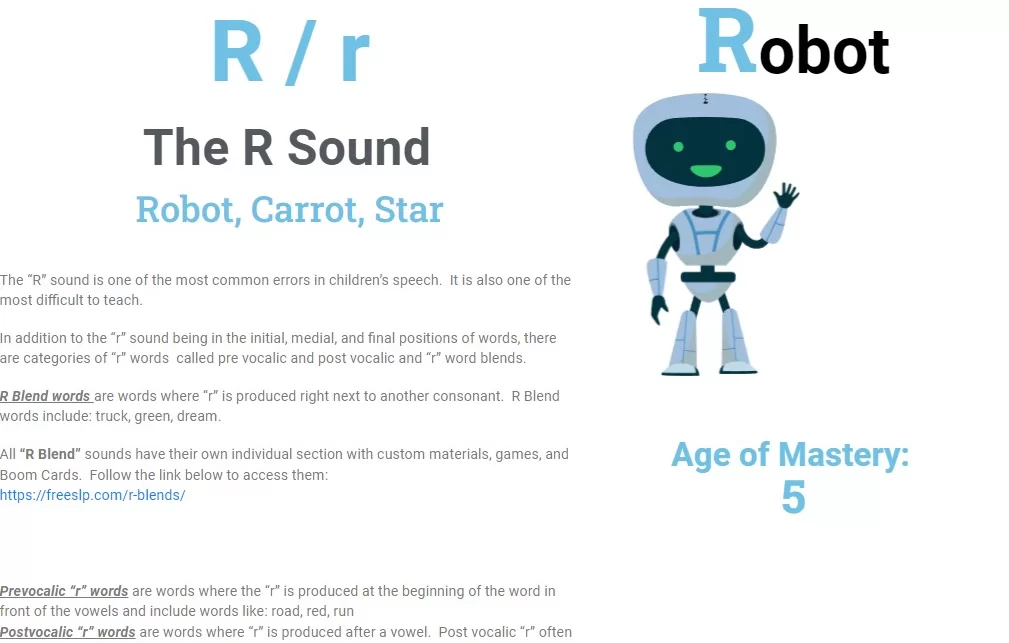
Most children produce the R sound correctly by age five and a half. However, some kids need more time and don’t master it until age seven. These age ranges represent normal developmental patterns.
If your child enters first grade still struggling with R sounds, consider consulting a speech-language pathologist (SLP). Professional guidance can determine if your child needs support.
Keep in mind that school districts follow different guidelines for R sound therapy. Some schools begin treatment in first grade (age 6-7), while others wait until second grade (age 7-8). Early assessment helps identify the right timing for intervention.
How to Help Your Child with the R Sound at Home
Consult with a Speech-Language Pathologist
Speech professionals provide expert guidance tailored to your child’s needs. If your child’s school doesn’t have an SLP, visit the American Speech-Language-Hearing Association website (www.asha.org/findpro) to find a qualified professional near you.
An SLP can evaluate your child’s specific speech patterns and create targeted exercises. These specialists have tools and techniques to make practice effective and fun.
Try the R Sound Recognition Game
Help your child develop their ear for the correct R sound with this simple game. Say a word with R correctly (like “rabbit”) and then incorrectly (like “wabbit”). Ask your child to identify which version has the correct sound.
Keep score as your child identifies correct R sounds. This game builds listening skills without pressure to produce the sound. Try these starter words:
- ring
- rain
- rock
- road
- rat
- wrap
- wrist
- reach
- rule
- ride
Model Positive Reinforcement
When your child says an R word incorrectly, avoid negative reactions or forcing them to repeat it. This approach often leads to frustration and reinforces incorrect patterns.
Instead, respond by modeling the correct pronunciation naturally. If your child says, “The ball is wed,” simply reply, “Yes, that is a red ball,” with gentle emphasis on the R sound. This provides a positive model without creating pressure.
Practice Through Play
Turn speech practice into fun activities. Read books with lots of R words or make up silly R stories together. Games keep children engaged while providing valuable practice.
Create a treasure hunt for toys with R in their names. Hide items like a ring, race car, or rubber duck around the house for your child to find and name.
Be Patient and Consistent
Developing new speech skills takes time. Celebrate small improvements and maintain a regular practice routine. Short, frequent practice sessions work better than occasional long ones.
Remember that your positive attitude makes a big difference. When you stay relaxed and supportive, your child feels more comfortable practicing difficult sounds.
R Sound Development Milestones
| Age | What to Expect |
|---|---|
| 3-4 years | Many children substitute W for R (“wabbit” for “rabbit”) |
| 5-5.5 years | Most children begin producing correct R sounds |
| 6-7 years | Some children still refining R sound production |
| 7+ years | Most children should have mastered the R sound |
Understanding R Sound Variations
The R sound actually includes several different variations depending on word position:
- Initial R – At the beginning of words (rabbit, run)
- Medial R – In the middle of words (carry, arrow)
- Final R – At the end of words (car, door)
- R Blends – Combined with other consonants (train, bring, dream)
- Vocalic R – When R follows a vowel (car, horn, hair)
Children often master these variations at different times. Many kids learn initial R first, while vocalic R combinations like “er” and “or” might take longer to develop.
FAQs About the R Sound
At what age should I be concerned if my child can’t say the R sound?
If your child still struggles with the R sound by first grade (around age 6-7), consider consulting with a speech-language pathologist. While some children naturally develop this sound by age 5.5, others may need until age 7. An evaluation can determine if your child would benefit from therapy.
Will my child outgrow R sound difficulties without therapy?
Some children do naturally develop correct R sounds without intervention. However, if your child hasn’t mastered the sound by age 7, they may benefit from professional help. Research shows that structured practice with a speech therapist leads to faster improvement than waiting for natural development.
How long does R sound therapy usually take?
The timeline varies for each child. Some children make rapid progress in just a few months of therapy, while others may need a year or more of consistent practice. Factors like practice frequency, motivation, and the child’s specific speech patterns all affect progress rates.
Should I correct my child every time they say the R sound incorrectly?
Constant correction can lead to frustration and reduced confidence. Instead of correcting, model the correct pronunciation naturally in your response. This provides a positive example without creating pressure or negative feelings about speaking.
Can other speech sounds affect R sound development?
Yes. Children who struggle with multiple speech sounds may have patterns that affect R production. For example, difficulties with L sounds sometimes occur alongside R sound challenges. A comprehensive speech evaluation identifies these patterns and addresses them appropriately.
Does R sound difficulty run in families?
Speech development patterns can have a genetic component. If you or other family members had speech therapy for the R sound, your child might be more likely to need support in this area. Sharing this family history with your child’s speech therapist provides helpful background information.
Conclusion
The R sound presents unique challenges due to its hidden tongue position and variations across different words. Most children master this sound between ages 5.5 and 7, but some need additional support.
If your child struggles with the R sound, remember that positive modeling and fun practice activities help more than pressure or correction. Consult with a speech-language pathologist for professional guidance tailored to your child’s needs.
With patience, consistent practice, and the right approach, your child can develop clear R sounds and speak confidently in all situations. The journey to correct R production may take time, but the results—improved communication and confidence—last a lifetime.
For more information on speech development and articulation disorders, visit FreeSLP.com for additional resources and support.